Trickle-Down Corruption
John Henry Faulk warned us. We didn't listen.

I know Trinidad, Texas.
I know it the way you know a town you’ve driven through a thousand times, the way you know the shape of its water tower before you see the town itself. I lived in Tool, just down the road, and drove my children through Trinidad every morning to get to school in Malakoff. We couldn’t go to school in Trinidad. When Cedar Creek Lake came in, Trinidad decided the kids from Tool weren’t worth the bus ride. Lake trash, they called us. I always believed it. It had that particular ring of truth that small towns specialize in.
I know that town in another way, too.
Some years back, a private prison company, Management and Training Corporation, a division of a Utah-based rocket-building outfit, had its eye on Trinidad. The plan was a “super intensive mandatory supervision” pre-parole work detail facility. Hard-core criminals, including sex offenders, released into the community to work during the day, back in lockup by night. Located near my children’s school. I figured no sane person could want this. I was woefully naive.
I arrived at the public hearing a half-hour early to find the community center already packed with blue-hairs from the Methodist church, canes tapping, orthopedic shoes squeaking, shuffling in like a geriatric production of Hee Haw meets Footloose. I stood outside and handed out flyers, statistics on recidivism, downloaded off a Republican state senator’s website, since I figured that might carry some weight.
Imagine my astonishment when thwack, the papers came flying back at me. Wads of paper pelted my head, my chest, my legs, like a very lopsided game of dodge ball. In a Methodist church. By people who were about to amen a prison pitch.
The company had promised them lower water bills.
That’s all it took. From that moment on, they heard nothing else.
One man came to my aid that night. He was a self-styled right-wing militia man who carried guns and had some very firm opinions about the federal government. His name was John Joe Gray. He lived on a 47-acre compound between Tool and Trinidad along the Trinity River. A few years later, he would become famous, if that’s the word, for conducting the longest armed standoff with law enforcement in American history. Nearly fifteen years on his property, the Henderson County sheriff declining to go in, saying it wasn’t worth getting his deputies killed. The charges were eventually dropped. Nobody told the sheriff’s office for two years.
That was my ally. In Trinidad, you take what you can get.
I won, in the end. The devil was in the details, and I knew someone in Austin who knew the details. The prison didn’t come. My friends stopped speaking to me. My children were maligned at school. A woman who had been helping me fight it woke up one morning to find her barn torched, the one that held all the building materials for her new home. And a local newspaper accused me of being a member of the anti-government movement.
Carol Countryman is a troublemaker, but not a militia mama, in Tool, Texas. That’s how the Progressive Populist ran my byline when I wrote about it.
I thought about all of this recently when I heard that Jennifer Combs, a Kerens resident, had been handcuffed in her front yard and spent 23 hours in the Navarro County jail on an arrest warrant from Henderson County.
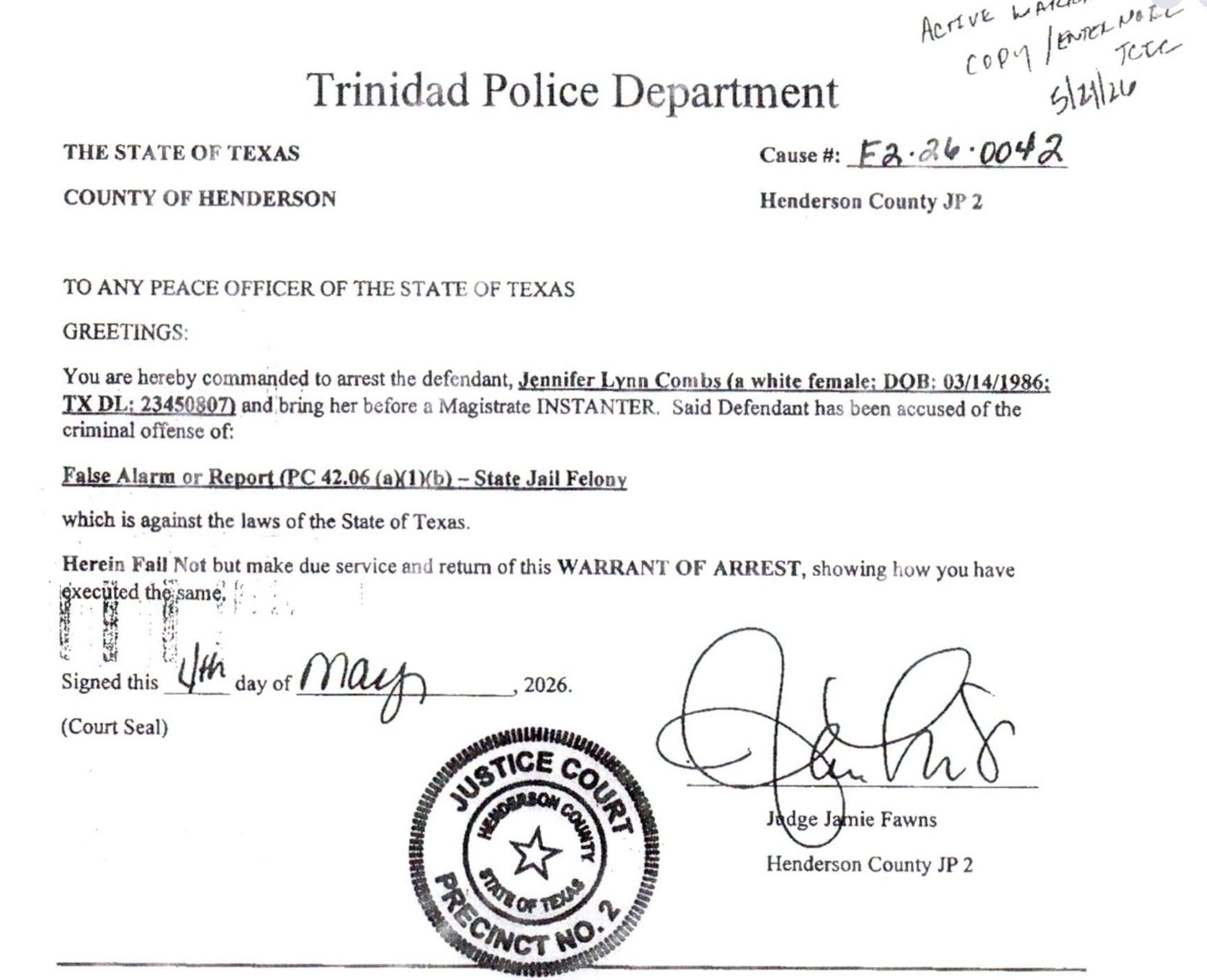
Her crime: a Facebook post. She had asked residents to report discolored water, sediment, strong odors, health concerns. Said she’d received reports of hospitalizations due to bacteria. She was gathering information and reporting it to the state. The Trinidad Police Department called it false information that “creates fear, panic, or unnecessary emergency response within a community.” Chief Charles Gregory called it “cut and dry.” They charged her with a felony.
Three weeks later, a Henderson County grand jury took about twenty minutes to no-bill the case.
Three weeks after that, Henderson County Judge Scott McKee, who reviewed the warrant, sent a letter to the police chief saying his officers had withheld material facts. They knew about the citizen complaints, the water quality concerns, and the context of Combs’ statements, and left all of it out of the warrant application. The judge wrote: “Material omissions can be as misleading to the probable cause determination as affirmative misrepresentations.”
Around the same time, a teenager in Trinidad was treated for what her family and doctors believed was a chemical burn from the city’s shower water. Her parents shared the medical records with Dallas Fox 4 News, which read: “Most likely chemical burn/severe dermatitis from water she was exposed to.”
The mayor confirmed the water pipes date to the 1950s. “A struggle, without question,” he said.
The police chief resigned. The city council fired the municipal judge who had dismissed related charges. They fired the city attorney. The water clerk filed a lawsuit saying she’d been fired for refusing to lie.
By June, citizens were calling for the city to be disbanded entirely. Jennifer Combs, the woman they had arrested for asking questions, had to explain why that wasn’t possible either. Under Texas law, a city cannot be dissolved while carrying outstanding debt. Trinidad, she wrote, is somewhere between $700,000 and $1.5 million in the hole. The city that arrested her for asking about the water can’t even afford to disappear.
Trinidad’s City Hall closed for several days. No reason given.
You could call all of this a local problem. A bad police chief. A dysfunctional council. An aberration.
Except it isn’t.
Twenty miles away, the City of Hawkins spent the better part of 2025 firing its entire police department, all of them, one by one, until there were none. According to multiple news sources, Mayor Debbie Rushing claimed the officers were not properly hired and didn’t receive council approval. The mayor was arrested herself in May for tampering with government records. The city faces sixteen lawsuits. It has no city attorney. A resident told reporters: “I’m not gonna call 911. I’m gonna protect my home and take matters into my own hands.”
In Zavalla, down in Angelina County, state regulators shut down the police department in May for violations so numerous the city faced $400,000 in fines. The county sheriff offered to cover them for $15,000 a year. The city council couldn’t get a second on the motion. The sheriff’s parting words: “I think you’ve done a huge disservice to the citizens of Zavalla.”
In Van, the city council fired the city manager. The mayor and a councilmember quit the next day. The whole thing started because the city manager had fired the police chief for organizing a community graffiti cleanup instead of writing citation letters to businesses that had been tagged, according to WFAA in Dallas.
In Henderson County—my county—residents packed the commissioners’ court in May to oppose data centers going up around Cedar Creek Lake. The county passed a resolution calling for tighter regulation. But by whom? Residents complained that the county was asking the fox to guard the henhouse.
Meanwhile in Lufkin, residents tried to address their city council about a proposed billion-dollar data center at a public meeting. According to the Texas Tribune, they were barred from speaking because the item wasn’t on the agenda. The city had declined to add it despite repeated requests.
When residents took their fight to the Angelina County Commissioners Court, the county judge told them plainly: “We have no authority to do a moratorium or stop any type of development in the county. Texas legislators have consciously limited what counties can do, and they’ve done it on purpose. They don’t trust us.“
He urged residents to call their state legislators. Those legislators were elected by the same people standing in that courtroom.
In Seven Points, Texas, a 2025 storm damaged the police department. Rape kits and DNA evidence lost refrigeration. Nobody moved them. Forty-nine days later, when the Henderson County District Attorney requested evidence for an active case, deputies found it still in the condemned building, rotting in mold and water. Thousands of dollars in cash from an active case were also missing. The Texas Rangers were called in. The police chief had already resigned.
Money is missing. Rape kits are destroyed. Life goes on.
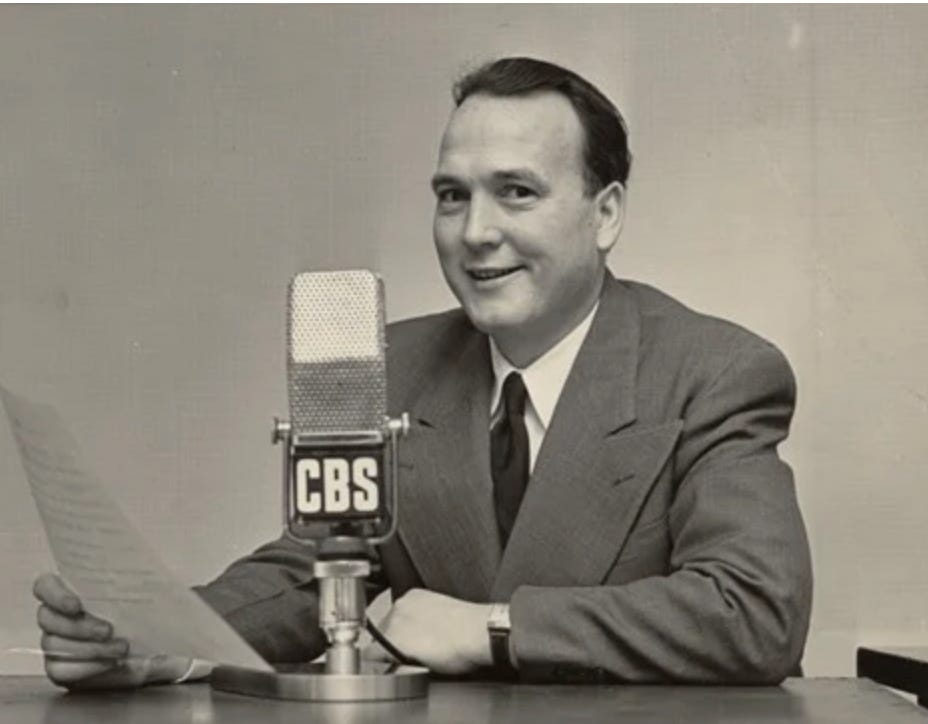
John Henry Faulk knew this. Faulk was a Texas folklorist and radio humorist who conducted one of the great First Amendment battles of the twentieth century. In the 1950s, a right-wing outfit called AWARE Inc. blacklisted him from CBS Radio for daring to oppose their operations during one of the sorriest times in the country’s history.
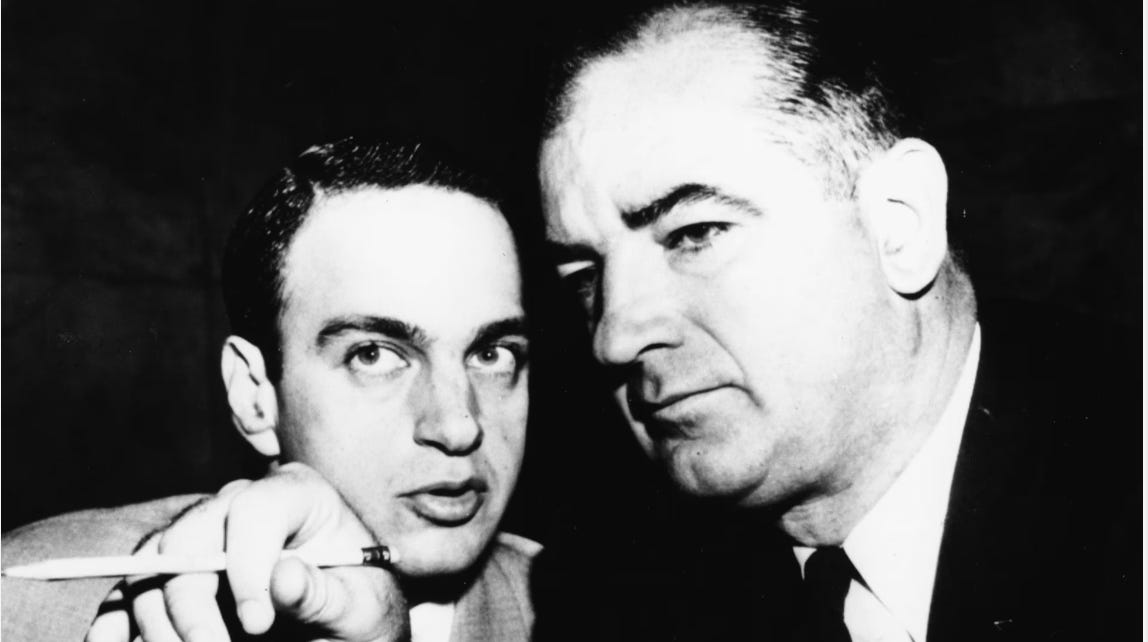
On the heels of the Cold War, Senator Joseph McCarthy and his protégé Roy Cohn ran the kind of operation that didn’t need a law to ruin you. Just a list and one accusation: communist. Cohn accused men of being homosexual, too. Some of them took their own lives. Turns out, Roy Cohn himself was homosexual, a fact he denied until his death. He died of AIDS in 1986, disbarred and disgraced.
In the late 1980s, Bill Moyers interviewed John Henry Faulk. I taped it on VHS and have watched it more times than I can count. I’ve read the transcript even more. I’ve also read Faulk’s own book, Fear on Trial, his account of those six years on the blacklist, written in his own hand. I know this material the way you know something that got under your skin and never left.
Sitting across from Faulk in that Moyers interview was Studs Terkel, a Chicago oral historian, Pulitzer Prize winner, guerrilla journalist with a tape recorder, and a man who knew the blacklist from the inside. His own television show had been canceled in the early 1950s for his leftist leanings. These weren’t two men discussing history. They were two survivors explaining the autopsy.
Terkel set the scene: the 1950s, the Cold War, loyalty oaths, Joe McCarthy, blacklists running the airwaves.
Moyers asked how it worked. “If you wanted to discredit an otherwise legitimate opponent—”
Faulk finished the sentence: “And didn’t want to argue over what the real issues were.”
Moyers: “You called him a Communist?”
Faulk: “Yes. They found the perfect way to shut off the political dialogue in our society and shut up dissent.”
That was 1950. The name has changed. Communist became socialist became woke became, and I am not making this up, vegan.
Faulk sued AWARE Inc. and won. It was the largest libel judgment in American history at the time. The networks still wouldn’t hire him.
He ended up on Hee Haw.
It was there, between cornfield jokes, that a man named Charlie Ferguson asked him how so many bad politicians keep getting elected.
Faulk’s answer: “Bad politicians are elected by good citizens who don’t vote.”
He said that about the 1950s. He could have said it yesterday.
Late night talk show host Stephen Colbert found out how current it was. For nine straight years, his show was the number one program in late night television. In July 2025, CBS canceled it (though it was ran through the rest of the season).
According to multiple media outlets, the network said it was, “Purely a financial decision.” This came four days after Colbert called a $16 million settlement between CBS and the Trump administration a “big fat bribe.” Trump had sued Paramount over a 60 Minutes interview, and Paramount had a merger pending before Trump’s FCC. CBS called Colbert “irreplaceable” and retired the franchise rather than replace him.
Trump posted on Truth Social: “I absolutely love that Colbert got fired.” Of course he did. That was Trump’s entire brand on The Apprentice. The American public ate it up every time he said, “You’re fired.”
Now consider Ken Paxton, who is asking Texas voters to send him to the United States Senate. He was indicted on felony securities fraud charges in 2015. He was impeached by the Texas House in 2023. He was acquitted by the Texas Senate. He was endorsed by a president who was convicted of crimes. His opponent is James Talarico, a former schoolteacher who holds a Master’s degree in Divinity and is in seminary.
The same Texans lighting torches over their city councils, the ones who watched their water run brown and got nowhere, who got locked out of public meetings about data centers on their own land, who watched their police departments implode in real time, many of them will pull the lever for Paxton in November. Not because they haven’t been paying attention. Because they’ve been given something to be furious at rather than furious about.
Talarico said it on the Joe Rogan podcast, of all places: “The wealthy and powerful use cultural issues to keep everyone distracted. I think of politics less as left versus right and much more as top versus bottom.”
Faulk used to tell a story about the time he and his friend Boots Cooper, both twelve years old, both barefooted in overalls, were sent by his mother to run a chicken snake out of the hen house. They went in armed with a hoe, frontier courage intact. They stood on tiptoe to look in the top tier of nests. A chicken snake looked back at them from six inches away.
Boots and Faulk made a new door through the hen house wall.
His mother came out and said the snake was harmless. Couldn’t hurt a soul. Boots Cooper, rubbing his forehead and his behind at the same time, said: “Yes, Mrs. Faulk, I know that. But they can scare you so bad, it’ll cause you to hurt yourself.”
All their frontier courage, Faulk said, had trickled down their overalls legs.
That’s what happened to America during McCarthyism. We got so frightened of a chicken snake that we hurt ourselves. And that fear, that manufactured terror of the wrong enemy, trickles down from a convicted president to an indicted attorney general to a police chief in Trinidad, Texas who handcuffed a woman for asking about brown water.
I call that trickle-down corruption. Same snake. Different hen house.
It’s still happening. The snake has a different name now—Communist. Homosexual. Socialist. Woke. The name doesn’t matter. What matters is the fear. What matters is who’s holding it up in front of your face and why.
This is what happens when the two-party system collapses at the local level. When you live in a state held by one party, people are either too scared to run against the machine or too complacent to bother. Nobody files. Nobody challenges. The seat fills by appointment. The appointment fills by friendship. And the official who was never tested by an opponent, never vetted by a real campaign, never forced to answer a hard question in public, starts to believe the office belongs to them. This is what one-party rule produces when it trickles all the way down to the bottom.
Faulk won the largest libel judgment of his time. But AWARE Inc. was always the Wizard of Oz, all thunder and curtain and no power behind it. The man who financed the whole operation died the night before the verdict. He had no money. The curtain came down on nothing.
Jennifer Combs noticed. She had a Facebook page and simply asked questions of her followers about their concerns with the water and was arrested for her trouble.
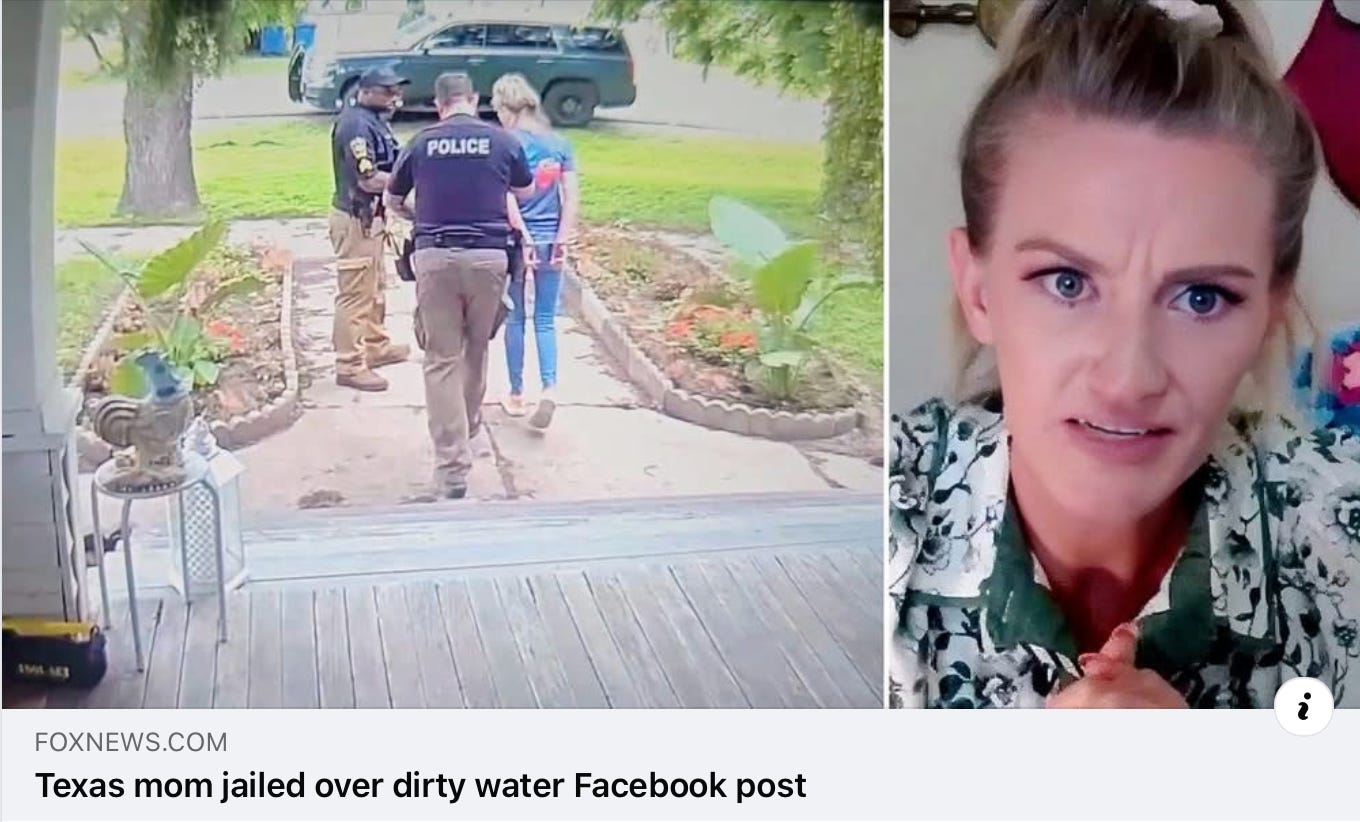
But the First Amendment didn’t let her down. It did exactly what it was built to do. It gave her the right to ask the question. What it can’t do is stop them from handcuffing you in your front yard for asking it.
Faulk understood that, too.
As of this writing, Jennifer Combs is still on Facebook. She recently posted about an upcoming city council meeting, laying out the city’s debt, explaining why the audits aren’t finished, telling people to show up and demand answers. The woman they arrested for asking questions is still asking them. In the comments, a Trinidad resident named Mercy Patterson wrote: “The people own the building. The people need to use their voice. The people need to vote because those that make decisions need to be held accountable.”
John Henry Faulk said it first. But he’d have been glad somebody in Trinidad finally said it too.
Years ago, when I fought the private prison that tried to come into Trinidad, the town council assured the citizenry that if they’d just support it, the city would lower the water bills.
Trinidad still has the same water pipes it had in 1950. The water is still brown. The water bill still comes monthly. And when someone asks a question, the city government still makes the question the problem.
Some things don’t change.
—Carol
Thanks for that. Very good explanation of an unfortunately timeless issue.
Thank you for taking us on a journey to the past. It's extremely frustrating the warning was and continues to be ignored.